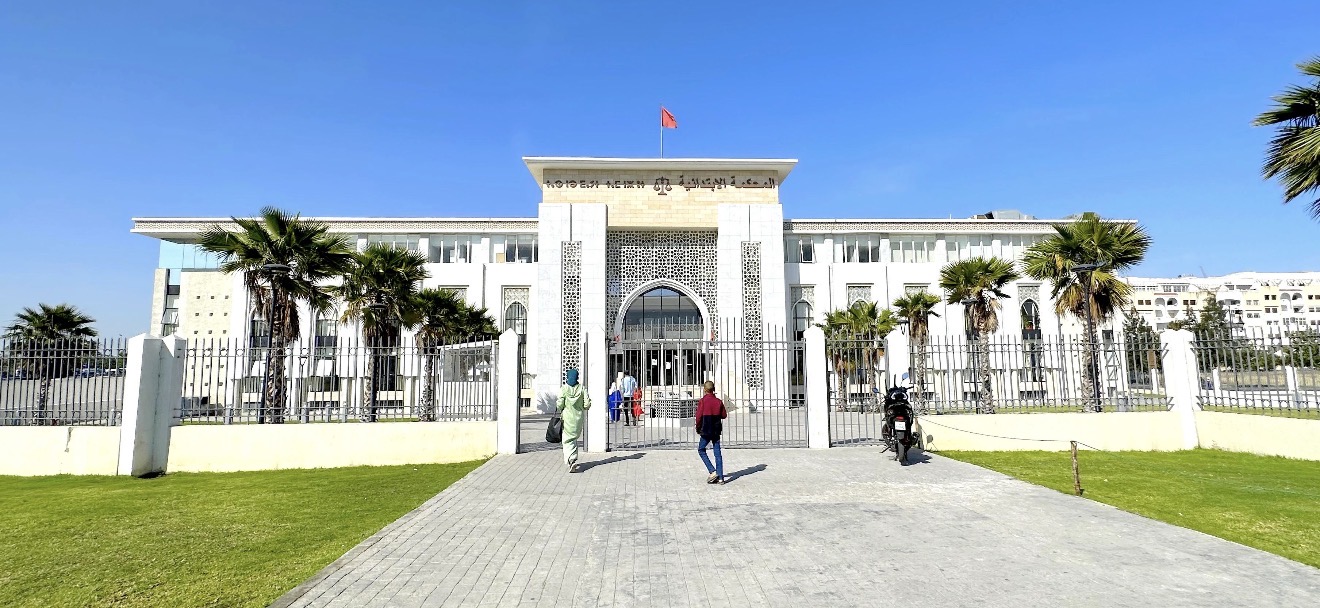
If you are applying for residency, a job, a marriage file, a school post or a UK/EU background check while living in Morocco, this is the building you need. The Tribunal de Première Instance de Tanger issues the casier judiciaire (criminal record certificate), handles civil, criminal and family cases, and registers sworn translators and bailiffs.
Where it is & how to contact
- Name: Tribunal de Première Instance de Tanger (المحكمة الابتدائية بطنجة)
- Area: Mghogha, alongside the N2, Tangier — large white courthouse set back behind palms and railings
- Phone: 05 37 21 37 37
- Typical hours: Monday–Friday, roughly 08:30–16:30 (counters often close for filings by 15:30; Friday afternoons are short)
- Map: open in Google Maps
- Bring your passport or CIN — you will not get past the entrance desk without ID.
How to get there
The courthouse is in Mghogha, set back from the N2. A petit taxi from the city centre costs about 20–30 MAD. Parking is limited, so arrive by taxi or use the drop-off lane directly outside the main gate.
Tribunal de Première Instance de Tanger
Mghogha, alongside the N2, Tangier, Morocco
Criminal record check (the Moroccan “DBS”) — apply here
There is no DBS in Morocco. The equivalent document is the casier judiciaire (bulletin n°3), also called the fiche anthropométrique when issued by the police. If you were born abroad, it is issued by the court where you live — for Tangier residents, that means this tribunal.
What to bring:
- Passport (or CIN for Moroccan nationals) + one photocopy
- Carte de séjour or récépissé if you are a resident + copy
- Full birth certificate (foreigners: apostilled and translated into Arabic or French)
- Completed request form — collected at the Bureau du Casier Judiciaire counter inside
- Timbre fiscal (tax stamp) — usually 20–30 MAD, sold at the tobacconist opposite or inside
- 1–2 passport photos (some counters ask, keep spares)
Cost & time: a few dirhams in stamps; collection is typically 24–72 hourslater, sometimes same day. Take the receipt — you need it to collect.
Validity: most authorities accept it for 3 months. Don't request it too early in your paperwork run.
For use abroad (UK, EU, employers, visas): after you collect it, get it legalised, then have a traducteur assermenté (sworn translator) produce an English or French version — 150–400 MAD per document. UK employers asking for a "police certificate" or "overseas criminal record check" will accept the translated casier judiciaire.
Foreigners born abroad who never lived in Morocco apply instead to the Ministry of Justice in Rabat (or online), but if you hold Tangier residency, apply here.
Everything else you can get here
- Casier judiciaire / bulletin n°3 — criminal record certificate (see above)
- Certificat de nationalité — nationality certificate for Moroccan nationals
- Marriage file approval — the family-affairs section (section de la famille) authorises marriage of foreigners to Moroccans, and handles divorce, custody and alimony
- Inheritance & succession acts — adoul (notary) certified deeds registered through the court
- Civil disputes — contracts, unpaid rent, deposits, contractor and landlord disputes
- Criminal cases at first instance — including complaints filed against you or by you
- Filing a complaint (plainte) — after a police report, the case passes to the Procureur du Roi here
- Legalisation of signatures & certified copies — for court-bound documents
- List of sworn translators & bailiffs (huissiers) — the official register is posted at the court; use it to find a translator whose stamp is accepted
- Property & land disputes — including title (titre foncier) challenges
- Company & commercial filings — small commercial matters within its jurisdiction
Practical tips from residents
- Arrive before 09:00 — queues build fast and counters stop taking files well before closing.
- Take cash in small notes for stamps and photocopies; nothing takes cards.
- Bring photocopies of everything, twice. There are copy shops outside but the queue costs you an hour.
- Forms are in Arabic and French. If your French is shaky, bring someone who reads Arabic.
- Dress smart-casual; shorts and beachwear are turned away.
- Nobody official will ever ask you for a "fee" in cash beyond the timbre fiscal. If someone does, they don't work there.
- Parking is limited alongside the N2 — a petit taxi from the city centre is 20–30 MAD.
FAQ
- Is the casier judiciaire the same as a UK DBS check?
- It is the Moroccan equivalent. UK employers, visa teams and safeguarding checks accept a casier judiciaire (bulletin n°3) issued by the court where you reside, legalised and translated into English by a sworn translator.
- Where do I apply for a criminal record check in Tangier?
- At the Tribunal de Première Instance de Tanger, at the Bureau du Casier Judiciaire counter. Bring your passport, residency card or récépissé, a copy of your birth certificate and a timbre fiscal.
- How long does it take and what does it cost?
- Usually 24–72 hours, occasionally same day. The cost is only the tax stamp, typically 20–30 MAD. Sworn translation afterwards costs 150–400 MAD per document.
- How long is it valid?
- Most Moroccan and foreign authorities accept it for three months from the issue date.
- Can someone collect it for me?
- Yes, with the original receipt and a notarised power of attorney (procuration) plus a copy of your ID.
- What are the opening hours?
- Broadly Monday to Friday 08:30–16:30, with counters closing earlier for new filings. Go in the morning, and avoid Friday afternoons and public holidays.
- Where is the Tribunal de Première Instance de Tanger?
- In Mghogha, alongside the N2 in Tangier — a large white courthouse set back behind palms and railings. A petit taxi from the city centre costs 20–30 MAD, and the page includes a Google map with directions.
- Do I need an appointment?
- No. The casier judiciaire counter and most public counters are walk-in, but queues build quickly, so arrive before 09:00.
- Can I get the criminal record certificate online in Morocco?
- Moroccan nationals born in Morocco can request bulletin n°3 through the Ministry of Justice online service. Foreign residents in Tangier apply in person at this court.
- Where do I get a sworn translation of the certificate?
- The court posts the official register of traducteurs assermentés (sworn translators) and huissiers. Use a translator from that list so the stamp is accepted; expect 150–400 MAD per document.
- Can I register a marriage between a foreigner and a Moroccan here?
- Yes. The family-affairs section (section de la famille) authorises marriage files for foreigners marrying Moroccan nationals, and handles divorce, custody and alimony cases.